“I don’t remember much of life before diabetes,” Asphodel Fisher says. Fisher, who uses she/they/he pronouns, clearly remembers the day of their diagnosis.
They were 10 years old, on spring break and heading out to make cupcakes with friends. Fisher felt tired, short of breath and sick, so their family took them to a small clinic in their hometown of Yakima, Washington. There, doctors found extremely high glucose and ketone levels in their blood. Left untreated, high ketone levels can quickly lead to diabetic ketoacidosis, a life-threatening condition that can cause severe illness or death.
Because there was no local specialty care, Fisher was flown across the state for emergency treatment for diabetes at Seattle Children’s. After being admitted, they spent a week learning the basics of diabetes care: checking blood sugar, giving insulin and understanding the routine that would now shape them.
Since then, Type 1 diabetes has been woven into nearly every part of their life.
“It’s been with me for as long as I can remember,” Fisher says. “It shaped who I am.”
Now 21, Fisher lives in Yakima, studies psychology at Heritage University and is learning how to manage diabetes on their own. They are one of more than 500 young adults who have found support through the Achieving Health in Emerging Adults with Diabetes (AHEAD) program, a unique partnership between UW Medicine and Children’s.
For Fisher, the program has turned diabetes from a “lifelong chore” into something else. “It feels more like a journey now,” they say.
The stress of transition
Fisher grew up with constant reminders of the disease: changing pump sites, planning meals and watching for warning signs. By high school, the daily demands began to wear them down.
“It felt like a merry-go-round I couldn’t get off,” Fisher says. They were experiencing what many young people call diabetes burnout, a deep exhaustion from managing a chronic condition day after day.
Things got harder as Fisher approached adulthood. Fisher now had to start handling insurance claims, scheduling appointments and dealing with device alarms going off in the middle of college classes.
“There isn’t a handbook for it,” Fisher says. “You just get thrown in.”
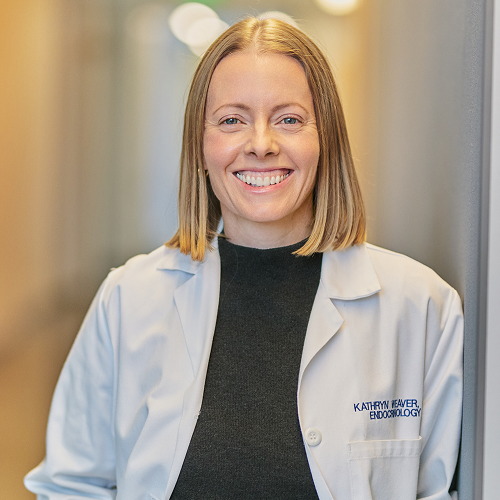
Kate Weaver, MD
Kate Weaver, MD, an endocrinologist at the UW Medicine Diabetes Institute and co-director of the AHEAD program, says Fisher’s experience is common. Young adulthood is one of the most dangerous times for people with Type 1 diabetes.
“We see A1C levels go up, and we see more diabetes complications during these years,” Weaver says. “At the same time, young adults are dealing with major life changes: school, jobs, relationships, money and mental health. It’s a perfect storm.”
Many young people are also unprepared to manage their care because much of their diabetes education happened when they were too young to take it in. “Their parents learned everything,” Weaver says. “Then at 18, we suddenly expect them to know it all.”
Filling in the gaps
Pediatric diabetes care is often team-based, with more time, more support and more mental health resources. In contrast, adult care is usually shorter and more medically focused.
“A lot of young adults get lost in the middle,” Weaver says.
To help fill that gap, AHEAD was created. The program was founded in 2017 by two leaders in the field: Irl Hirsch, MD, of UW Medicine, and Catherine Pihoker, MD, of Children’s. They had seen the same problem for decades — young adults struggling, falling through the cracks and ending up in emergency rooms or avoiding care altogether.
Today, the program operates across both Seattle Children’s and the UW Medicine Diabetes Institute, supporting teens at Seattle Children’s and following them as they age out of pediatric care and move to the UW Medicine system, usually between ages 18 and 21.
The AHEAD program stands out because of the team behind it. Patients see an endocrinologist (a diabetes specialist), a diabetes nurse educator, a dietitian, a social worker and a psychologist, who all work together to provide coordinated care. This level of wrap-around support is far greater than what most young adults receive in a traditional diabetes clinic.
The program is built on a patient-centered philosophy. It focuses on helping young people build skills, confidence and independence while teaching them the basics of diabetes management, from understanding A1C levels to knowing how insulin and alcohol affect blood sugar. It also encourages young adults to take the lead in their care by handling tasks like scheduling appointments and managing refills.
At the same time, the team works to build trusting relationships, so patients feel understood and supported rather than judged.
“We view patients as experts on themselves,” Weaver says. “Our job is to support, not criticize.”
For Fisher, this approach changed everything.
Care with compassion
For Fisher, the biggest shift came from meeting with a psychologist in the AHEAD program who understood diabetes burnout and helped them rethink their relationship with the disease. Instead of seeing diabetes as an enemy, Fisher began thinking of it as a part of their body they could work with.
“When my A1C was high, I was scared and embarrassed,” Fisher says. “But the team never judged me.”
During one difficult period, Fisher’s A1C climbed to around 10%, a level that can be dangerous. But instead of reacting with blame, the AHEAD team focused on compassion. That was the moment Fisher realized they were not failing, they were simply struggling — and there was help.
“I used to feel like I had to fight my body,” Fisher says. “Now I try to work with it.”
Regular lab work through the program also helped doctors catch hypothyroidism early, something Fisher believes would have gone unnoticed much longer without the AHEAD program.
Built on philanthropy, aiming for a new standard of care
The AHEAD program was created with support from a long-time anonymous donor whose generosity has helped build the program and sustain patient care.
“This kind of giving is rare,” Weaver says. “Many donors focus on cutting-edge research, focusing on finding a cure for Type 1 diabetes or device development. But funding clinical care creates immediate impact right now, for real people.”
Because the AHEAD model is not standard care, it depends on philanthropy to operate. Along with operating costs, early donations have also helped launch research on the program, showing that AHEAD patients had lower A1C levels and lower diabetes distress than those in standard care.
This data helped secure funding from Breakthrough T1D, formerly the Juvenile Diabetes Research Foundation.
In January 2026, the program will begin a major randomized controlled trial at Children’s. The study will follow more than 300 patients over three to five years to test whether AHEAD’s model is more effective and costs less than standard care.
If it succeeds, Weaver hopes it could become a national model.
Support on a lifelong journey
For Fisher, diabetes is still a constant presence. But with the AHEAD program, they no longer face it alone. For now, their goals are simple: keep their A1C steady, continue working through burnout and growing their independence, all while studying psychology. Fisher’s dream is to become a therapist who works with chronically ill patients just like them.
“Give yourself grace, trust yourself and don’t be afraid to lean on your support system,” Fisher says.
The journey is still lifelong, but now, it is a journey taken with support, understanding and hope.
Written by Patsy Cadwell