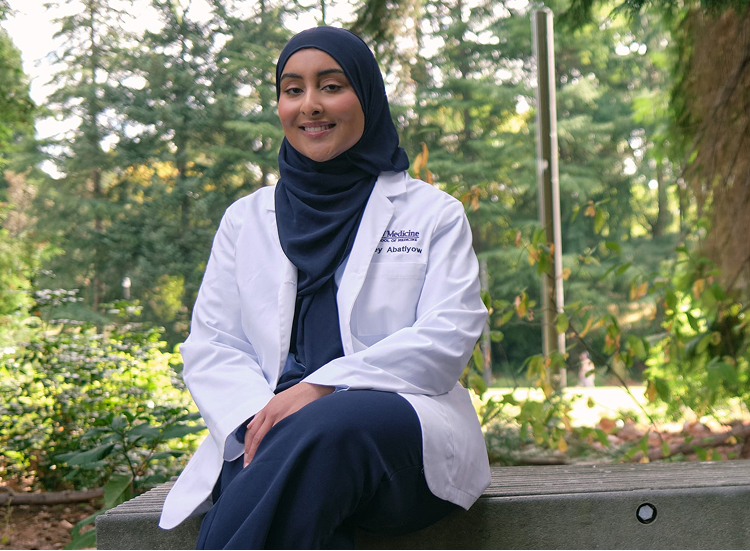
Biley Abatiyow
I was born and raised in Seattle, the child of Somali immigrants. I started building a community here well before I started medical school — I volunteered at the Somali Health Board, East African Community Center and Seattle Children’s Hospital.
As a student at the UW School of Medicine, doing rotations in Seattle clinics, I’ve been able to see a whole different side of this community.
I fell in love with medicine through my family. Growing up, I spent a lot of time accompanying family members to doctors’ appointments. My grandfather in particular relied on me to help him communicate with doctors and interpret paperwork, since I spoke better English than he did.
My family also talked about the barriers they faced in the healthcare system, whether that was transportation, difficulties with language or just struggling to connect with a doctor.
Those experiences got me interested in medicine. They made me want to break down barriers by making it easier for people from different backgrounds to interact with the healthcare system. That’s how I ended up choosing to major in medical anthropology and public health as a UW undergraduate.
Pursuing research opportunities, whenever they appear
As a kid, I would hear my parents talk about the kind of healthcare they got in Somalia and compare that experience to healthcare in the U.S. That sparked an interest in how care differs around the world.
As an undergraduate, I worked on a research project where I studied the differences between home and hospital births in pregnant people of East African descent. Specifically, I looked at what these patients needed to give birth safely.
Studying public health also led to my involvement in basic science research. I was looking at the impact of malaria in other countries — specifically sub-Saharan Africa — when I learned about a study happening at Seattle Children’s on the malaria parasite. I started working on that study as an undergraduate and continued after I graduated, though there was a brief hiatus due to COVID-19.
This research project, which looked at the molecular aspects of drug resistance and how genetics can impact the effectiveness of malaria drugs, was a great opportunity to combine my love of basic science and lab work with my interest in medicine. I even contributed to several published papers on malaria parasite genetics!
I love research. I know it can be hard to balance with clinical work, but I hope to continue doing research after I graduate with my MD. I’ve always been open to whatever is thrown at me — if I have a great opportunity, I’ll pursue it.
“My scholarships have had a major impact on me — one I plan to pay forward.”
Being myself means breaking down barriers
I’ve always been proud to wear the hijab — I was even interviewed by the Seattle Globalist in 2017, when I was an undergraduate, as part of a story about Muslim women who choose to wear the hijab.
Doing my clinical rotations has driven home my pride in wearing the hijab, and the importance of doing it. There have been times when I’ve walked into the clinic and seen a patient’s eyes brighten at the sight of a medical student in a hijab, because they’re seeing someone who looks like them. I’ve always wanted to provide for my community and to break down the kinds of barriers to care my family faced. Wearing the hijab is a way to do that.
Wearing the hijab also allows me to embody my values while demonstrating that someone like me — a Muslim woman, a woman who wears a hijab, whose parents didn’t go to college — can succeed in a field like medicine. I hope I can encourage others to see themselves in different roles, whether that’s a doctor, a lawyer, an engineer or a CEO.
Scholarships have been an important part of getting this far. Medical school is physically and mentally draining as well as very expensive. The expenses go beyond tuition: You have to pay to take the United States Medical Licensing Examinations (USMLE), you need to be able to buy textbooks and you need a working computer.
When I was doing a rotation in Edmonds, my car broke down and I needed to get it fixed. Having a scholarship gives me peace of mind, because I can deal with those financial concerns.
I’m so grateful to the donors who support scholarships for medical school. My scholarships, from the Donna C. and Lloyd Hostetler Endowed Scholarship, Durward A. Huckabay, MD Endowed Scholarship Fund, Everett Orville Jones, MD, Endowed Scholarship Fund, Irwin-Collison Memorial Endowed Scholarship Fund and the UW Medicine Endowed Scholarship Fund, have had a major impact on me — one I plan to pay forward. I currently volunteer helping students from underrepresented groups with their college applications, and I want to do more in the future.
As told to Alex Israel