The Scientists Rewriting Nature’s Chemistry
Researchers are creating new ways to treat disease and repair the planet — with real-world impacts sooner than most people realize.
Climate change, pollution and the depletion of natural resources don’t just degrade our environment — they’re harming health and driving up healthcare costs.
The car you drive burns fuel that contributes to climate change and produces air pollution linked to heart and lung disease. Much of the food in stores comes in plastic that never biodegrades, breaking into tiny particles now found in water, soil and our bodies, with potential to harm our cells and cause inflammation. Even fresh produce often depends on fertilizers and pesticides that can contaminate ecosystems and drinking water, posing health risks.
Given enough time, life would adapt to the environmental impact of human activity. But we’re moving too fast for evolution to keep up.
Nature has given us a remarkable tool that could offer our best solution: proteins. These molecular machines carry out essential jobs in every living thing, from fighting deadly infections to capturing energy from the sun.
The question now is whether we can learn from nature’s chemistry and use it to fix the problems we’ve created — and develop better ways to advance medicine, sustainability and technology moving forward.
Nobel laureate David Baker, PhD, believes we can.
“Custom-designed proteins could help tackle some of the biggest challenges facing human health and the environment,” Baker says. “The potential is enormous. Instead of asking how we can solve these problems, it’s what problems do we want to solve now?”
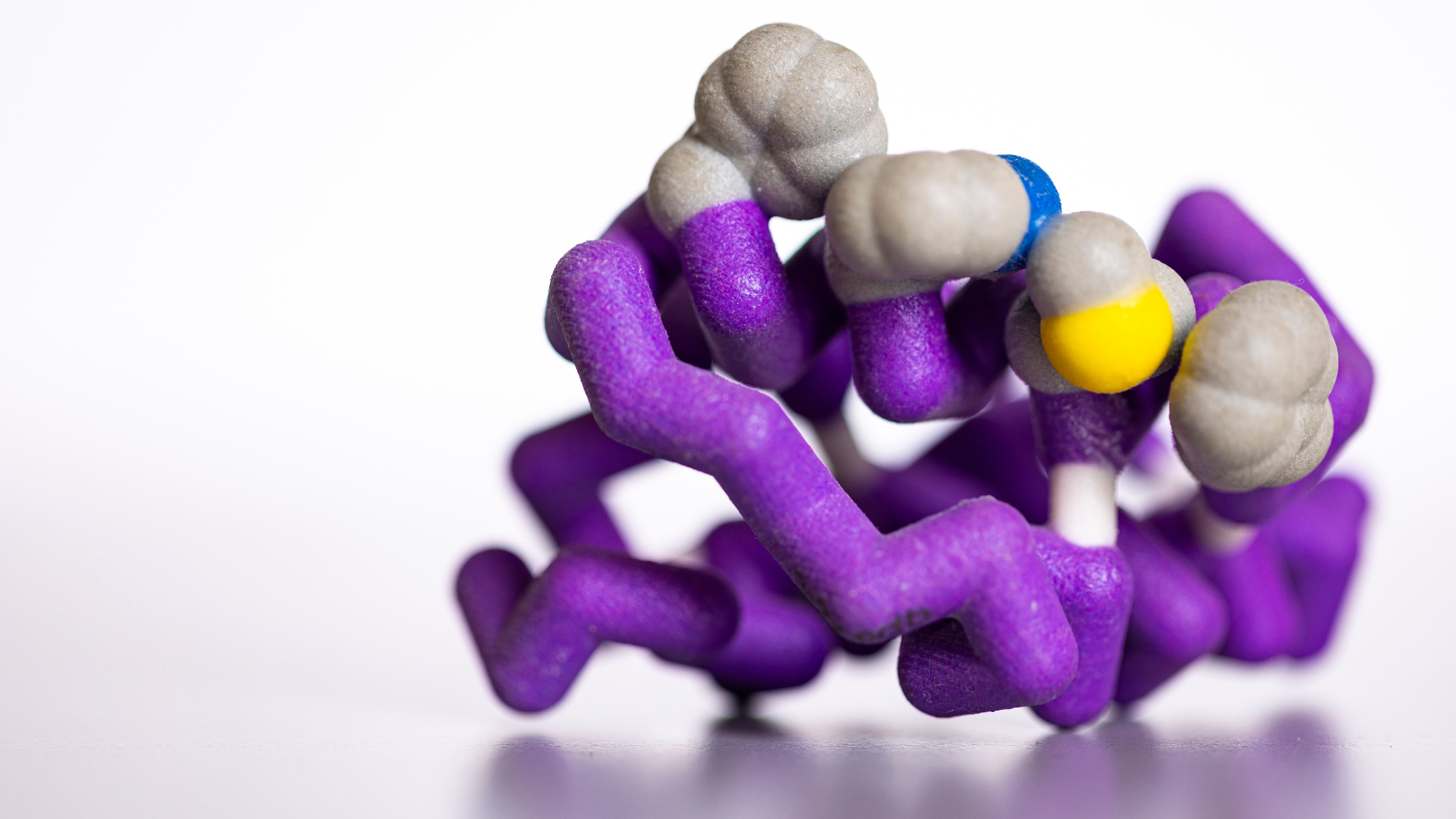
The IPD has become the global center for creating custom proteins with atomic-level precision.
Programming biology: designing proteins from scratch
Until recently, scientists could only study proteins that already existed in nature. Researchers tried to tweak these molecules to change their behavior. The idea of designing entirely new proteins from scratch seemed far-fetched.
Today, thanks to the University of Washington Institute for Protein Design (IPD), it’s one of the most promising new fields of science.
Founded in 2012 by Baker, the IPD has become the global center for creating custom proteins with atomic-level precision. These molecular machines can be engineered to perform specific tasks — from targeting cancer cells to detecting pollutants or capturing greenhouse gases.
In essence, scientists are beginning to program biology. Just as software engineers write code that makes a computer program perform a function, protein designers can now build new molecular structures designed to do a particular job.
Artificial intelligence is accelerating the work. Advanced models can predict how proteins will behave, shrinking what once took years of trial and error into months of design and testing. Much of this computing happens on UW campus servers, where researchers are also improving efficiency so the energy demands of the models continue to shrink.
The results are already reshaping medicine. Research from the IPD led to the world’s first computationally designed protein vaccine for COVID-19, approved in 2022 in South Korea. A universal flu vaccine based on similar technology is now in human clinical trials.
The institute’s discoveries have also helped launch more than a dozen biotechnology companies, attracting more than $1.8 billion in venture investment and helping establish Seattle as the epicenter of the protein design revolution.
Having shown what protein design can do in medicine, scientists are now turning these same tools toward the environmental challenges that increasingly shape both planetary and human health.
"Custom-designed proteins could help tackle some of the biggest challenges facing human health and the environment. The potential is enormous. Instead of asking how we can solve these problems, it’s what problems do we want to solve now?"
Solving problems evolution can’t
Many of today’s environmental problems share a simple fact: They’re new. Plastics, synthetic chemicals and industrial pollutants have existed for only about a century. Over evolutionary timescales, life could adapt through random mutations or natural selection.
Protein design offers a different approach.
“For the last century we’ve relied on brute-force chemistry — heat, pressure and toxic metals — to make the materials we need,” says Baker. “But biology solved many of these problems billions of years ago. Protein design lets us start using the same precise chemistry that living systems use.”
Scientists at the IPD are designing enzymes — specialized proteins that catalyze chemical reactions — that could help capture and store carbon dioxide at scale across agriculture and manufacturing. Other enzymes could enable plants or microbes to metabolize methane, a greenhouse gas far more harmful than carbon dioxide.
Pollution is another challenge proteins can solve quickly. Plastics and “forever chemicals” (like PFAS used to make products nonstick and water-resistant) were invented to be resilient, so much so that they are nearly impossible for natural systems to break down, resulting in toxic buildup in our environment. These substances are now found in water, soil and even the human body, where they are linked to cancer, hormone disruption and other health risks. The IPD is developing enzymes that could dismantle these molecules into safer parts, breaking down millions of toxic compounds in seconds.
Manufacturing could change as well. Nearly 95% of industrial products rely on chemical reactions that use toxic metals, large amounts of energy, or harsh solvents that wind up in the environment. IPD researchers are creating enzymes that can often perform the same reactions in water, with remarkable precision and far less waste.
The shift is simple but powerful. Instead of forcing chemistry to do what we want, often with unintended side effects, scientists can work with the same molecular tools life has used for billions of years.
The challenge now is getting these life-changing proteins out of the lab and into the world where they can do the most good — and that requires visionary philanthropic support.
"Within the next five years, we could see protein design technologies capable of delivering real solutions to pressing environmental challenges at scale. It redefines what a healthier future for humanity might be. It changes the world."
Where philanthropy matters most
Scientific breakthroughs rarely move in a straight line. Many of the most important advances begin with transformative discoveries that are too new, uncertain, or early for traditional funding.
Government grants usually fund research aimed at solving a specific problem, such as curing a disease or developing a drug. Private companies tend to invest later, once a technology can be produced at scale and generate a return.
But donor support can provide the initial, critical funding for high-risk, high-reward ideas.
At the IPD, this support allows scientists to focus on the foundational tools that make the field possible. Improving the AI models that design proteins, for example, may not directly target a single disease or product. But those advances can broadly enable breakthroughs across medicine, agriculture, manufacturing and environmental science.
Philanthropy also helps move discoveries beyond the laboratory. Before industry can scale a new technology, scientists must show that it works in the real world. Donor support funds those early proof-of-concept experiments — the steps that turn promising ideas into practical solutions for the people and places that need them most.
“Within the next five years, we could see protein design technologies capable of delivering real solutions to pressing environmental challenges at scale,” Baker says. “It redefines what a healthier future for humanity might be. It changes the world.”
Written by Nicole Beattie
Photo credit: Mark Stone / University Photography