Twenty years ago, the Institute for Stem Cell and Regenerative Medicine (ISCRM) at UW Medicine was founded on the bold idea that stem cells — cells that are the body’s building blocks, capable of transforming into specialized types of cells such as muscle, blood or nerve cells — could change medicine.
Created by visionary scientists, the institute has focused on developing therapies to repair, replace or regenerate damaged cells, tissues and organs to restore normal function. This vision has helped move regenerative medicine from theory to real-world science.
And that bold idea has led to meaningful progress. Researchers now use stem cells to better understand diseases like Alzheimer’s, modeling the disease in ways that reveal how it takes hold in the brain. They are exploring new ways to advance the field of tissue engineering, which uses stem cells to create healthy tissues in the lab that one day could help replace damaged organs or repair injuries, including the heart. They are developing new treatments using gene-editing tools that have been FDA-approved for treating muscular dystrophy. Along the way, ISCRM has brought leading scientists to Seattle and trained the next generation of innovators.
As ISCRM marks its 20th anniversary, Jennifer Davis, PhD, is stepping into the director role at a defining moment. She carries forward a legacy of tackling big challenges, driven by the question: Why aren’t we curing more chronic disease?
“We’re sitting on the backs of giants,” Davis says. “Our responsibility is to honor that history by pushing the science further.”
“We have the tools. We have the expertise. We have a culture of collaboration. What we’re most excited about is the possibility of helping people live healthier lives.”
Leading discovery, advancing care
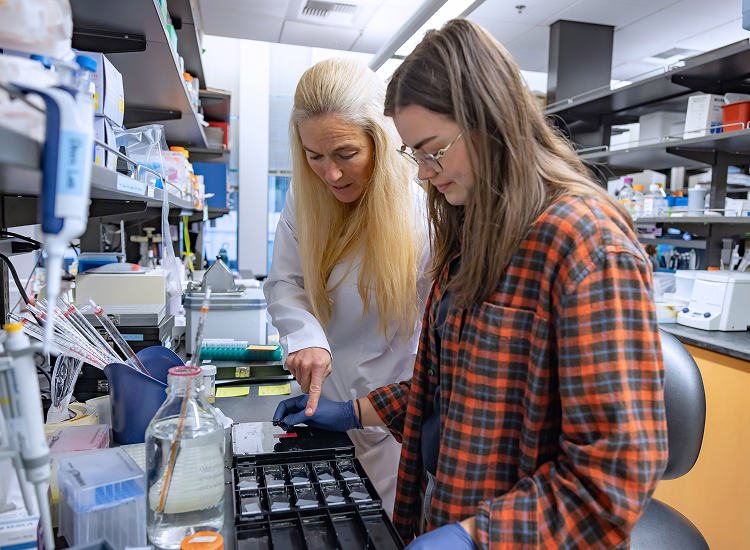
Davis’ path to this moment was not a traditional researcher’s path. She earned her bachelor’s and master’s degrees in kinesiology and exercise science, studying how muscles grow and adapt. She later pursued a PhD in molecular and integrative physiology, where she focused on the basic cellular and molecular drivers of heart disease.
Since joining ISCRM in 2015, Davis has played a key role in advancing its mission. She has served in leadership roles, including associate director and interim director, helping guide research programs, strengthen collaboration and support faculty and trainees. Her work has helped build the foundation for the institute’s next phase of discovery.
In her own lab, Davis studies the biology of heart disease at its most basic level. She focuses on how the heart responds to injury and how scar tissue shapes that healing process. While scar tissue can help hold the heart together after damage, it can also weaken its ability to pump over time. Using genetic tools, her team has identified key signals that control how this scar tissue forms. By understanding and potentially guiding that process, her work aims to improve recovery and restore heart function for patients.
ISCRM shares a singular unifying goal: to understand disease at its root and treat the cause, not just manage symptoms.
Davis’ work on heart disease clearly demonstrates the challenge. Billions of dollars are spent each year on medications and procedures that help patients live longer. However, many treatments only delay damage rather than reverse it. Patients often need to take medications for life.
Davis says, “We’re not curing heart disease, we’re managing it.”
She believes regenerative medicine offers a path to change that.
The next phase: “Stem Cell 2.0”
Some organs, like skin and blood, regenerate well. Others — including the heart, lungs and kidneys — do not. Stem cells can be guided to become specialized tissues. They are powerful tools for modeling disease and, increasingly, for repairing damage.
However, many stem cells grown in the lab resemble immature cells. Because these cells do not fully mature, they also cannot develop disease the way they do in the human body. Conditions like heart disease take years, even decades, to develop in response to biological and environmental changes. Studying those diseases in immature cells is a bit like trying to understand heart disease by studying a healthy fifth grader.
For researchers, that presents a major challenge. Stem cells are both powerful instruments of discovery and tools for treatment. Scientists use them to understand how diseases begin, test new therapies and repair damaged tissue. But to reach their full potential, the cells must better reflect how human cells behave throughout life, fully capturing what happens to patients’ bodies over time.
Davis foresees transformative advances ahead in ISCRM’s next 20 years, starting with what she calls “Stem Cell 2.0.”
Her vision centers on “smart cells.” These engineered cells would include built-in logic circuits. Like a smart car that senses the road, a smart cell could sense its environment and respond. Researchers could potentially guide cells to mature and age in ways that more closely mirror human biology, creating more accurate disease models and more effective therapies. These cells could survive in hostile tissue, resist rejection and adapt in real time.
“It sounds futuristic,” says Davis. “But the technology is finally catching up.”
Seattle’s unique research ecosystem makes that ambition possible. Advances in protein design led by David Baker, PhD, at UW Medicine’s Institute for Protein Design and partnerships across the University of Washington and with the Allen Institute provide tools few institutions can match.
Building the future: the biofoundry and beyond
To make Stem Cell 2.0 a reality, Davis believes researchers need more than new ideas. They need new infrastructure and new ways of working together.
Her answer is a biofoundry — a centralized hub where researchers can build, edit, age and bank high-quality stem cells and organoids, small lab-grown tissues that mimic organs. The goal is to give scientists access to advanced cellular tools that can better model disease and accelerate the development of new therapies.
Today, many researchers build these tools independently, often recreating similar systems in different labs. A biofoundry would bring those resources together into one shared space, allowing scientists across disciplines to access high-quality cells and tissues without starting from scratch.
Instead of each lab working in isolation, scientists could draw on shared, ready-to-use components. Davis describes it as “Lego-block science.”
Within a year, she hopes scientists will be able to request heart or brain organoids from a core facility. Over time, the biofoundry’s goal is to manufacture patient-specific tissues at scale, in partnership with engineering experts. Researchers could one day access engineered cells and organoids that more closely reflect how disease develops in the human body, including models built from a patient’s own cells. By standardizing and sharing these tools, the biofoundry could accelerate discovery and bring new therapies to patients faster.
Building that kind of infrastructure takes more than scientific talent. It requires early belief and a coordinated investment in equipment, personnel and shared space, but Davis believes the payoff could transform medicine.
And philanthropy can play a crucial role in making that possible.
Moonshot science rarely fits neatly into traditional funding models. Early-stage ideas that blend synthetic biology, engineering and regenerative medicine often need proof of concept before federal agencies will invest. Seed funding helps researchers gather data needed to compete for national grants — and take the kinds of risks that lead to breakthroughs.
Davis has experienced the power of philanthropy firsthand. As a researcher, she was awarded a $50,000 Tietze Stem Cell Scientist Award in 2017, which allowed her to build a stem cell with a built-in force sensor. That early data has led to major federal funding and will fund over a decade of research.
“That early support unlocked everything,” says Davis.
A future powered by radical collaboration
Just as important as the infrastructure are the people who power it.
Davis believes that one of ISCRM’s greatest strengths is its radical collaborative culture. The institute’s approach is built on the idea that solving the biggest challenges in medicine requires bringing together people with different expertise, ideas and perspectives.
More than 180 labs across UW Medicine and the University of Washington share ideas, tools and data. Bioengineers work beside stem cell biologists. Clinicians partner with basic scientists to ensure discoveries move from the lab to the clinic, directly impacting patient care. Experts in computation, engineering and biology work together to solve problems that no single field could tackle alone.
“People here want to go after the big ideas,” Davis says. “I’ve never gone to someone and had them say no. They say, ‘Yes, let’s figure this out together.’”
That spirit of collaboration is what allows ISCRM to take on ambitious goals, from creating smarter cells to developing new ways to study and treat disease. The biofoundry represents that philosophy in action: a shared resource where researchers can combine their expertise and build on one another’s discoveries.
Trainees are at the center of that work. Graduate students, postdoctoral fellows and undergraduates are not just learning science; they are helping drive it forward. Working alongside leading researchers and physicians, they bring new ideas, energy and curiosity to the work.
“The best day of my job is when a trainee defends their research,” says Davis. “They are the engine behind all of this.”
By supporting the training of the next generation of scientists and physician-researchers, ISCRM strengthens the future of care.
As ISCRM enters its third decade, Davis feels both urgency and optimism.
“What we’re most excited about is the possibility of helping people live healthier lives,” she says. “What if we could help heart attack patients fully recover? Free a child from insulin dependence? Protect a grandmother’s memory before Alzheimer’s disease takes hold? Or get patients off dialysis and transplant lists? That’s within reach.”
Her vision is bold — that ISCRM becomes internationally recognized not only for building new scientific platforms, but for curing disease.
“We believe we can revolutionize medicine,” says Davis. “And this is the moment to go after the moonshot.”
Written by Patsy Cadwell