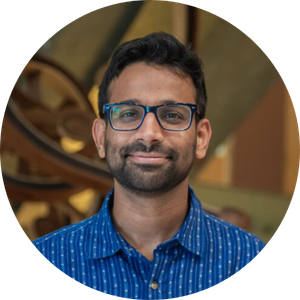
Sudarshan Pinglay, PhD
“BBI is going to have an outsized impact on both healthcare and our understanding of fundamental biology,” says Sudarshan Pinglay, PhD. “We’re really inventing new biology, going beyond the constraints of what evolution has given us.”
BBI was founded in 2017, thanks to a visionary investment from Jeff and Susan Brotman and Pamela and Dan Baty. BBI is a collaboration among UW Medicine, Fred Hutch Cancer Center and Seattle Children’s.
Scientists at BBI work at the leading edge of synthetic biology, a field in which UW Medicine is a global leader. In addition to BBI, UW Medicine founded the Institute for Protein Design (IPD), led by recent Nobel laureate David Baker, PhD. IPD is globally renowned for its success in using data science and artificial intelligence to create synthetic proteins, opening up a world of treatments that don’t exist in nature.
Now, scientists at BBI are rapidly expanding what is possible in the field by using artificial intelligence and machine learning to both understand disease and create genes that are not found in nature.
In short, BBI scientists are doing with cells what IPD does with proteins. And one day, those experiments could allow scientists to cure genetic diseases by literally rewriting DNA.
How to catalog a genome
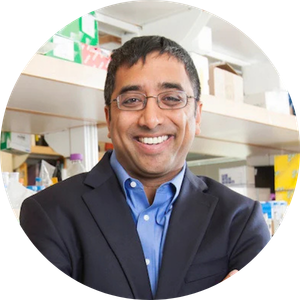
Cole Trapnell, PhD
In the decade since its founding, scientists at BBI have been working to decode the human genome, cataloging variants and making it possible to identify genetic diseases well before a patient shows symptoms.
“In the last 10 years, there’s been an explosion in cataloging potentially problematic mutations. We don’t, however, know if those mutations are going to cause problems, or how they will,” says Cole Trapnell, PhD, a UW associate professor of genome sciences whose research is funded by BBI.
Lea Starita, PhD
Much of the cataloguing work has been done by Lea Starita, PhD, and Doug Fowler, PhD, Trapnell’s colleagues at BBI. “Their work really motivates me in my work,” continues Trapnell. “Closing the gap between genetic information and health would be much easier if we had a complete map of genetic mutations, sort of a Google Maps for the human genome.”
BBI is at the leading edge of genome mapping, developing many of the technologies used by genome scientists worldwide and leading an international effort to map genetic variants.
Doug Fowler, PhD
“The collection of people involved in BBI, along with the kind of work it supports, creates a singular institution,” says Pinglay.
BBI’s scientists are strong in both descriptive genetics — the work of sequencing and cataloging genetic mutations — and experimental genetics, which involves making changes to genes in experimental models and observing the results. These two complementary fields work together to achieve the full potential of synthetic biology.
“Right now, when a patient gets their genome sequenced, you don’t know which mutations might lead to disease in the future or what kind of disease they might cause,” says Trapnell. “The dream of precision medicine is that a patient’s care team looks at their genome, identifies potentially problematic mutations and helps that patient make a decision now to prevent future problems.”
Pinglay goes even further, envisioning a future where genes can be edited to cure disease — before it starts.
“With experimental genetics, we can create a model, alter the genetic code and see what happens,” he says. And when those kinds of experiments are done on a large scale, they can lead to genetic therapies that cure conditions by rewriting DNA.
New technologies make an impossible task possible
The scale of BBI’s work is vast — there’s far too much data for a team of human researchers to analyze. It’s because of that scale that AI and machine learning have been critical to Trapnell and Pinglay’s work.
“Every single experiment generates a massive amount of data. We can’t possibly look at it all, so we write programs that look at it and tell us what’s important,” says Trapnell. “Artificial intelligence is good at finding both what’s expected, based on the scientific literature, but also what’s unexpected.”
“There are so many moving pieces when it comes to biology, it’s unintuitive for the human brain to process,” says Pinglay. “AI models allow us to abstract away some of the complexities and focus on what can help us with our end goal: designing new biology.”
Trapnell’s lab combines the strengths of AI and conventional machine learning to advance biomedical research. AI tools, including large language models, help the team access and synthesize vast amounts of scientific knowledge that would be difficult to process otherwise. Conventional machine learning methods then provide the quantitative modeling and predictive power needed to forecast the effects of genetic changes, which the lab tests experimentally in model organism zebrafish.
“By combining AI to navigate complex biomedical data with machine learning to make and test predictions, we can explore how changes in genes play out in living systems,” says Trapnell.
Rewriting the process of scientific collaboration
In addition to funding leading-edge synthetic biology experiments, BBI is creating a new model for large-scale interdisciplinary collaboration by bringing together researchers from different specialties with a wide variety of skills.
“BBI is ultimately about people,” says Trapnell. “Right now, there aren’t great career pathways for people who want to stay in science after finishing a PhD or a postdoctoral fellowship but want a more collaborative position than becoming a principal investigator and leading a lab.”
BBI offers an alternative model for those scientists. “The single-cell core at BBI is made up of full-time staff,” Trapnell says as an example. “They’ve spent the past several years scaling up lab-developed technologies. It’s the kind of team you would find in pharma, but they’re here, at an academic institution, and our work wouldn’t be possible without them.”
Pinglay agrees. “There are other places doing great science,” he says. “BBI is special not just because of the science we’re doing but the way we’re doing it. It’s creative, collaborative, collegial and fun.”
A visionary investment in the future of human health
Jay Shendure, MD, PhD
The synthetic biology advances coming out of BBI and IPD could only have come from a major university located in a thriving technological hub. The combination of UW Medicine’s research excellence and clinical expertise and Seattle’s tech-rich ecosystem created a fertile environment in which synthetic biology can take root.
However, BBI wouldn’t have gotten where it is today without visionary support from donors. The founding donors planted the seeds for BBI’s innovative research.
“If it weren’t for Jeff, Susan, Pam and Dan, BBI wouldn’t exist,” says Jay Shendure, MD, PhD, lead scientific director at BBI. “The future patients who benefit from this work will have them to thank.”
A later collaboration among BBI, the Allen Institute and the Chan Zuckerberg Initiative helped those seeds blossom into the Seattle Hub for Synthetic Biology (SeaHub).
Today, donors have the opportunity to build on this philanthropic legacy by fueling the scientific advances that will lead to new cures and treatments for genetic diseases.
“The kind of science we do at BBI is pretty out there,” says Pinglay. “An NIH review panel wouldn’t necessarily want to fund it.”
The scale of the work being done at BBI also creates funding challenges. “The initial project was enormous, and it had to be — you can only do this kind of modeling if you have a huge amount of data,” says Trapnell. “Government funding agencies wouldn’t have taken the risk, even if the potential is enormous.”
Now more than ever, philanthropy is the engine that drives research advances and leads to exciting new cures and treatments. The BBI, the IPD and UW Medicine are uniquely positioned to lead the next wave of innovation in synthetic biology — and support from donors can help their scientists push forward into new waves of precision medicine.
By Alex Israel