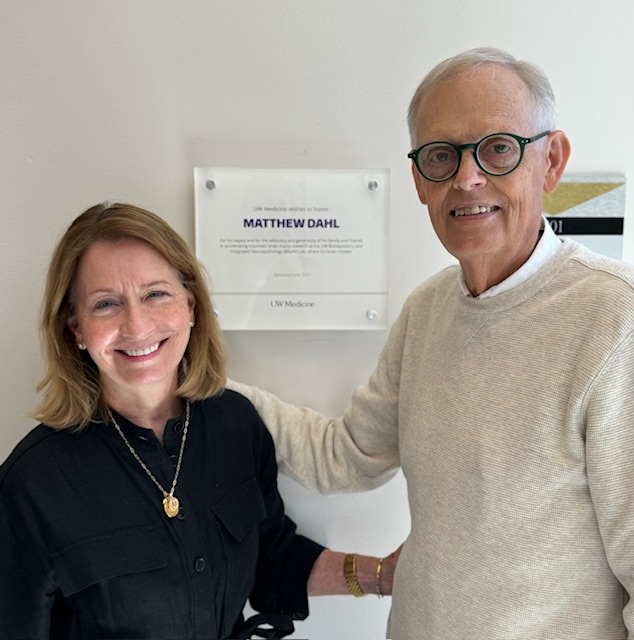
Linda Dahl and her late husband, Bob, are being recognized with the 2026 Ragen Volunteer Service Award.
Linda Dahl and her late husband, Robert (Bob), first came to UW Medicine’s Biorepository and Integrated Neuropathology Laboratory — the BRaIN lab — in 2019 looking for answers.
Linda and Bob’s son, Matthew (Matt), died by suicide in 2019 at age 24 after five years of worsening depression. Matt and his parents believed that his depression could be related to a head injury sustained from falling out of a window when he was five years old. His doctors, however, had ruled out the connection, since he’d appeared to recover and had not shown symptoms of depression until the age of 19.
Following Matt’s death, Linda and Bob asked the BRaIN lab — led at the time by C. Dirk Keene, MD, PhD — to analyze Matt’s brain to better understand his injury. Keene’s examination determined that Matt’s childhood traumatic brain injury had evolved, rather than resolved, and likely led to his later symptoms.
Matt, Linda and Bob had been right; Matt’s symptoms were related to his head injury, but very little was known about the biology of the injury and what caused it to evolve. That lack of answers inspired Linda and Bob to become active supporters of the BRaIN lab’s research. Their commitment to raising funds and awareness for the BRaIN lab is being recognized with the 2026 Ragen Volunteer Service Award.
“We’re just two parents who had a wonderful, wonderful kid, our only child,” says Linda. “We are heartbroken. Working with the BRaIN lab gave us answers about Matt, a purpose as we navigate the grief of his death and some hope for others who may suffer like Matt did.”
A bittersweet honor
Named for the late Brooks G. Ragen, the Ragen Award honors volunteers who have made outstanding contributions toward advancing the mission of UW Medicine.
For Linda, finding out she and Bob would be receiving the Ragen Award was profound in more ways than one. She and Bob had spent their lives as a team — raising Matt, helping him when he struggled and then raising money and increasing awareness for the BRaIN lab.
Then, in 2025, Bob died, the result of an aggressive glioblastoma brain tumor. Bob’s brain is now also part of the BRaIN lab’s biorepository, and is already part of a major study focused on brain cancer.
“The award is bittersweet, because Bob isn’t here,” says Linda. “I just think about how he would have been so humbled to receive it.”
A leader in TBI research
Linda and Bob came to the BRaIN lab looking for answers and ended up finding purpose. Their commitment to fundraising for the lab stemmed from Keene’s passion for his research and compassion for the brain donor families.
“Dirk didn’t just talk about a brain,” says Linda, “he talked about Matthew’s brain and how important it was to research.”
Shortly after meeting Keene and learning about the BRaIN lab’s work, friends and family began to ask where they could donate in Matt’s honor. The clear answer was the BRaIN lab.
Those first gifts in Matt’s honor were the start of a seven-year — and counting — journey for Linda and Bob. The funds and awareness they raised supported brain donation and helped the lab hire Amber Nolan, MD, PhD, who now leads the lab’s traumatic brain injury (TBI) research that was kick-started by Keene’s examination of Matt’s brain.
Nolan attended an early event the Dahls hosted at the BRaIN lab shortly after starting at UW Medicine. At that event, she learned about Matt’s brain and the Dahls’ story.
“Seeing the video about Matt’s brain and meeting the Dahls at that event affirmed that I was in exactly the right place,” says Nolan. “I am inspired every day by the Dahls and the need to help those like Matthew who struggle — often many years later — with the ‘invisible’ wounds of brain injury.”
Linda and Bob’s work with the BRaIN lab also helped them find a community.
In 2020, after learning that Kris and Eric Lambright had donated their father’s brain — UW coach Jim Lambright — Bob and Linda reached out. That initial outreach led to a long-term friendship dedicated to supporting the BRaIN lab, including co-hosting annual events to raise funds and awareness for TBI research.
“We currently have major grants coming to UW Medicine, all built on the funds provided by generous donors to the BRaIN Lab,” says Keene. “This research didn’t exist at UW ten years ago.”
One such grant, NEW-HOPE-TBI, was awarded to the BRaIN lab — in partnership with Icahn School of Medicine at Mount Sinai and Massachusetts General Hospital — in 2025. This five-year research study, led by Nolan and her co-PI at Mount Sinai, focuses on the cognitive effects of TBI.
Loyalty born out of love
“I think a lot about a quote from Allen Levi’s book ‘Theo of Golden’: ‘For anything to be good, truly good, there must be love in it,’” says Linda. “Our advocacy started out of love for Matthew and has continued to become his legacy.”
“Linda and Bob have made an enormous contribution to the study of the brain,” says Keene. “Without their steadfast support and their large group of dedicated donors, we would not have been able to grow and ultimately make the advances we have over the past seven years.”
“I’m so excited to work with Linda and continue the great work she and Bob have done over the years,” says Caitlin Latimer, MD, PhD, the incoming director of the BRaIN lab.
For Linda, the award isn’t so much a tribute to the work she and Bob have done as it is a way to shine a spotlight on the BRaIN lab’s work.
“The BRaIN lab collaborates with researchers across the country and around the world. They’re doing remarkable work,” says Linda. “And I know, without a doubt, Matthew would be so proud to be part of what they are accomplishing.”
Written by Alex Israel